
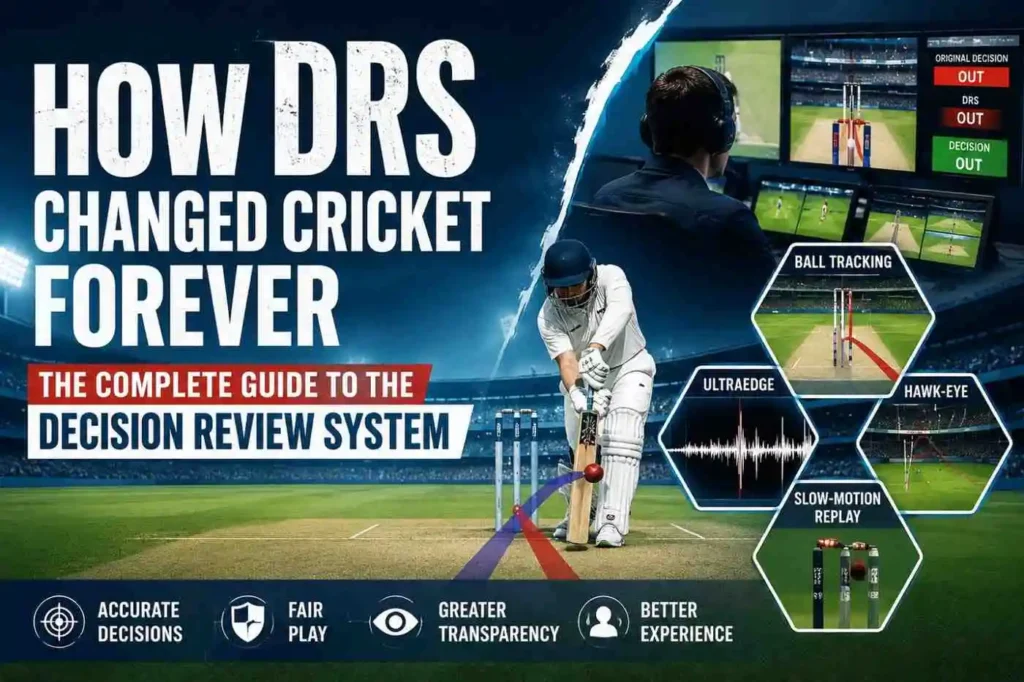
Cricket has always been known as the “gentleman’s game,” but even the best umpires can make mistakes. With matches becoming faster, more competitive, and watched by millions around the world, a single incorrect decision can completely change the outcome of a game. To reduce human error and improve fairness, the International Cricket Council (ICC) introduced the Decision Review System, commonly known as DRS.
Today, DRS is one of the most discussed technologies in international cricket. Whether it is an LBW appeal, a close catch, or an edge behind the wicket, DRS helps officials make more accurate decisions using advanced technology. While it has received praise from players, fans, and experts, it has also sparked debates over its limitations.
This guide explains how DRS works, the technology behind it, its benefits, challenges, and how it has transformed modern cricket.
Table of Contents
ToggleWhat Is DRS?
The Decision Review System is a technology-based process that allows players to challenge certain on-field umpire decisions. Instead of relying only on the umpire’s judgment, DRS combines video replays and tracking technology to review controversial moments.
The system was introduced to improve accuracy and reduce the impact of obvious human errors. It is now a regular part of most ICC tournaments and bilateral international series.
Why Was DRS Introduced?
Before DRS existed, many incorrect umpiring decisions became memorable moments in cricket history. A wrong LBW decision or an unnoticed edge could eliminate a team from an important tournament.
The growing availability of television technology made it possible to review decisions more carefully. As a result, cricket authorities developed a structured review system that gives teams a limited opportunity to challenge decisions.
The primary objective of DRS is not to replace umpires but to assist them in making fair and consistent decisions.
How Does DRS Work?
The review process begins when a player believes the umpire’s decision is incorrect. The captain or batter has only a few seconds to signal for a review.
Once the review is requested, the third umpire examines multiple pieces of evidence using different technologies.
Ball Tracking
Ball tracking predicts the path of the cricket ball after impact. It estimates whether the ball would have hit the stumps and is mainly used for LBW decisions.
UltraEdge
UltraEdge detects tiny edges between the bat and the ball. Sensitive microphones and visual waveforms help determine whether contact occurred before the ball reached the wicketkeeper or slips.
Hawk-Eye Technology
Hawk-Eye uses several cameras placed around the stadium to create a three-dimensional model of the ball’s movement. It provides accurate replay angles and assists in judging ball trajectory.
Slow-Motion Replays
High-speed cameras capture every frame in detail, allowing officials to review catches, stumpings, boundary decisions, and run-outs from multiple angles.
Types of Decisions Reviewed Through DRS
Several types of umpiring decisions can be reviewed during a match.
LBW Appeals
These are the most common DRS reviews. Ball tracking helps determine whether the delivery pitched in line, hit the batter legally, and would have gone on to hit the stumps.
Caught Behind
UltraEdge helps identify whether the bat made contact with the ball before it reached the wicketkeeper.
Run-Outs
Multiple camera angles allow third umpires to decide whether the batter crossed the crease before the bails were removed.
Stumpings
Slow-motion footage helps determine whether the batter’s foot remained behind the crease when the wicket was broken.
Boundary Decisions
Video technology confirms whether the ball touched the boundary rope or whether a fielder remained inside the field of play.
The Umpire’s Call Rule
One of the most debated aspects of DRS is the “Umpire’s Call.”
If the ball tracking shows only a marginal impact with the stumps, the original on-field decision remains unchanged. This rule respects the umpire’s judgment when technology cannot provide complete certainty.
Although controversial at times, Umpire’s Call was introduced to balance technology with human decision-making.
Advantages of DRS
The introduction of DRS has brought several improvements to international cricket.
Improved Accuracy
Incorrect decisions have reduced significantly compared to the pre-DRS era.
Fair Competition
Both batting and bowling teams receive an equal opportunity to challenge questionable decisions.
Greater Transparency
Television viewers can watch the review process live, making umpiring decisions easier to understand.
Increased Confidence
Players generally trust important decisions more when advanced technology has been used.
Better Viewing Experience
The review process adds excitement and allows fans to understand the reasoning behind difficult decisions.
Limitations of DRS
Despite its success, DRS is not perfect.
Ball tracking predicts future ball movement rather than measuring it directly after impact, meaning slight uncertainty remains. UltraEdge may occasionally detect unrelated sounds, requiring careful interpretation by the third umpire.
Weather conditions, camera quality, and viewing angles can also influence certain reviews. For these reasons, experienced officials continue to play an essential role alongside technology.
Memorable DRS Moments
Over the years, DRS has influenced many famous international matches. Several World Cup games, Test matches, and ICC finals have featured dramatic reviews that changed momentum at crucial stages.
These moments demonstrate how technology has become an integral part of modern cricket rather than simply an optional tool.
The Future of Cricket Technology
Cricket technology continues to evolve. Artificial intelligence, improved tracking systems, higher-resolution cameras, and faster data processing may further enhance decision-making in the coming years.
Experts also believe that future systems could provide even more precise ball-tracking models and quicker reviews without interrupting the pace of the game.
Final Thoughts
The Decision Review System has permanently changed international cricket by combining technology with traditional umpiring. While no system can eliminate every controversy, DRS has significantly improved the accuracy, fairness, and transparency of the game.
As cricket continues to embrace innovation, technologies such as Hawk-Eye, UltraEdge, and ball tracking will remain central to maintaining the integrity of the sport. For players, officials, and millions of fans worldwide, DRS represents an important step toward making cricket more accurate, balanced, and enjoyable for everyone.
If you enjoyed learning about DRS and modern cricket technology, you may also like: The Complete History and Evolution of the Cricket World Cup