
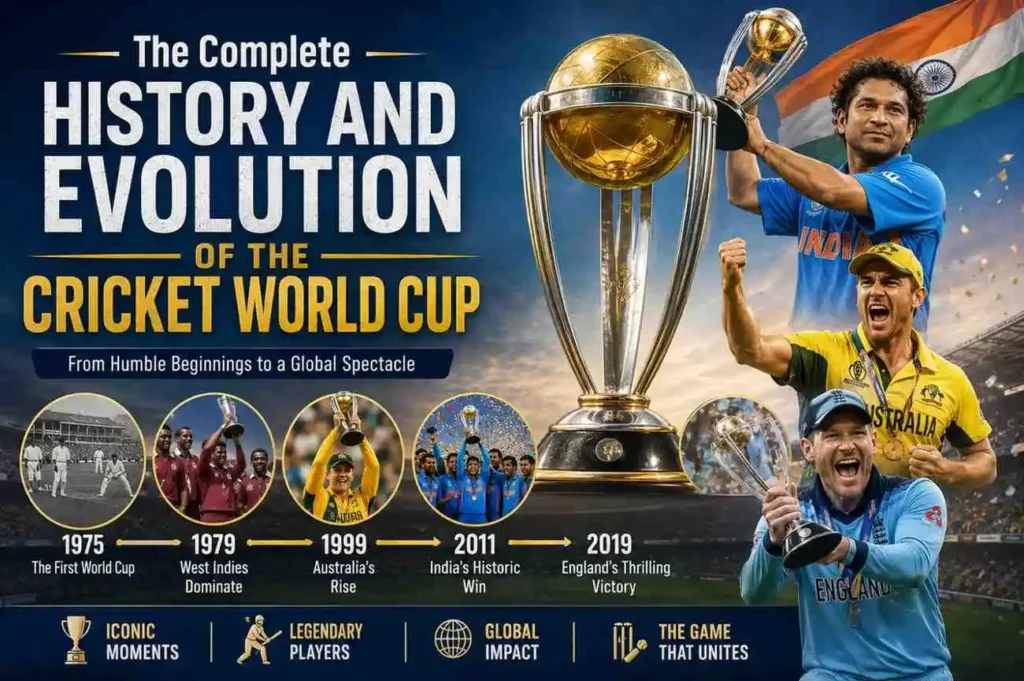
The Cricket World Cup stands today as one of the most watched sporting events on the planet, drawing hundreds of millions of viewers across continents. Yet the tournament’s journey from a modest experiment in English cricket grounds to a global spectacle spanning multiple formats and billions of fans is a story worth understanding in full. This guide walks through the complete evolution of the tournament, the changes it has undergone, and why it continues to capture the imagination of cricket fans everywhere.
Table of Contents
ToggleThe Origins of the Tournament
Before the World Cup existed in its current form, international cricket was largely confined to Test matches, which could stretch across five days and often ended without a clear result. As the sport grew in popularity through the 1960s and early 1970s, cricketing boards recognized the need for a shorter, more accessible format that could crown a single global champion in a matter of weeks rather than years. This need eventually gave birth to the concept of a One Day International tournament that could bring together the best teams in the world under one roof.
The First World Cup in 1975
The inaugural Cricket World Cup was held in England in 1975, featuring eight teams competing in a 60-overs-per-side format. The tournament was sponsored by Prudential and is often remembered as the Prudential Cup. The West Indies emerged as the first-ever champions, defeating Australia in a thrilling final at Lord’s. This tournament set the template for what would become a quadrennial global event, establishing England as a natural host given its cricketing infrastructure and favorable summer weather.
The Growth Through the 1980s
The success of the 1975 edition led to a follow-up tournament in 1979, again hosted in England, where the West Indies once more claimed the title, defeating England in the final. The real turning point, however, came in 1983, when India, considered massive underdogs, stunned the cricketing world by defeating the mighty West Indies in the final at Lord’s. This victory is widely credited with transforming cricket’s popularity across the Indian subcontinent, laying the foundation for what would eventually become the sport’s largest fan base and commercial market.
Expansion Beyond England
In 1987, the World Cup left England for the first time, jointly hosted by India and Pakistan. This edition also marked a shift from 60 overs to 50 overs per side, a format that remains standard in ODI cricket to this day. Australia won this tournament, defeating England in the final. The move to the subcontinent signaled cricket’s expanding global footprint and showed that the tournament could thrive outside its traditional English home.
The 1990s and the Rise of New Powers
The 1992 World Cup, held in Australia and New Zealand, introduced coloured clothing, white balls, and day-night matches for the first time, dramatically changing the visual identity of the sport. Pakistan won this edition under the captaincy of Imran Khan, a victory that remains one of the most celebrated moments in Pakistani sporting history. The 1996 World Cup returned to the subcontinent, hosted by India, Pakistan, and Sri Lanka, with Sri Lanka producing a surprise triumph that reshaped the balance of power in world cricket.
The Turn of the Millennium
The 1999 World Cup in England saw Australia begin what would become a period of extraordinary dominance, defeating Pakistan in the final. This victory marked the start of a run in which Australia would go on to win three consecutive World Cups, a feat unmatched in the tournament’s history. The 2003 edition, hosted by South Africa, Zimbabwe, and Kenya, again ended with Australia lifting the trophy, this time against India, further cementing their status as the format’s most dominant side.
The 2007 and 2011 Tournaments
The 2007 World Cup, held in the West Indies, is remembered for Australia completing their hat-trick of titles, defeating Sri Lanka in a final that was controversially played into fading light. However, the tournament also faced criticism for its length and format, prompting organizers to rethink the structure for future editions. The 2011 World Cup, hosted jointly by India, Sri Lanka, and Bangladesh, delivered one of the most emotional victories in the sport’s history as India lifted the trophy on home soil, with Mahendra Singh Dhoni’s iconic six sealing the win against Sri Lanka.
The Modern Era
The 2015 World Cup in Australia and New Zealand saw Australia claim their fifth title, once again showcasing their consistency in the format. In 2019, England hosted the tournament and won their first-ever World Cup title in a final against New Zealand that had to be decided by a boundary count after both the match and the Super Over ended in a tie, arguably the most dramatic finish in the tournament’s history. The 2023 edition returned to India, where Australia claimed a record sixth title, defeating the host nation in front of a record crowd.
How the Format Has Evolved
Over the decades, the World Cup has evolved significantly in structure. The tournament expanded from eight teams in 1975 to as many as fourteen in later editions, before organizers experimented with different formats to balance competitiveness with commercial appeal. Technology has also transformed how the tournament is officiated, with the introduction of third umpires, the Decision Review System, and ball-tracking technology all making their debut or becoming standard during various World Cup cycles.
The Cultural Impact of the Tournament
Beyond the cricketing achievements, the World Cup has played a significant role in shaping national identities and cricketing cultures. India’s 1983 triumph is often cited as the single biggest catalyst for cricket’s commercial explosion in the country. Pakistan’s 1992 win under Imran Khan became part of the nation’s broader sporting folklore. Sri Lanka’s 1996 victory put the island nation firmly on the global cricketing map. Each triumph has left a lasting cultural legacy that extends far beyond the boundary rope.
Looking Ahead
As the tournament continues to evolve, discussions around format changes, associate nation participation, and scheduling remain ongoing topics within the cricketing world. What remains constant, however, is the tournament’s ability to produce moments of pure sporting drama that stay etched in the memory of fans for generations. From Lord’s in 1975 to Ahmedabad in 2023, the Cricket World Cup has consistently delivered on its promise of crowning cricket’s ultimate champions on the biggest stage possible.
Also Read: India vs Zimbabwe T20I Series 2026: Shreyas Iyer Hunts First Win As Captain