
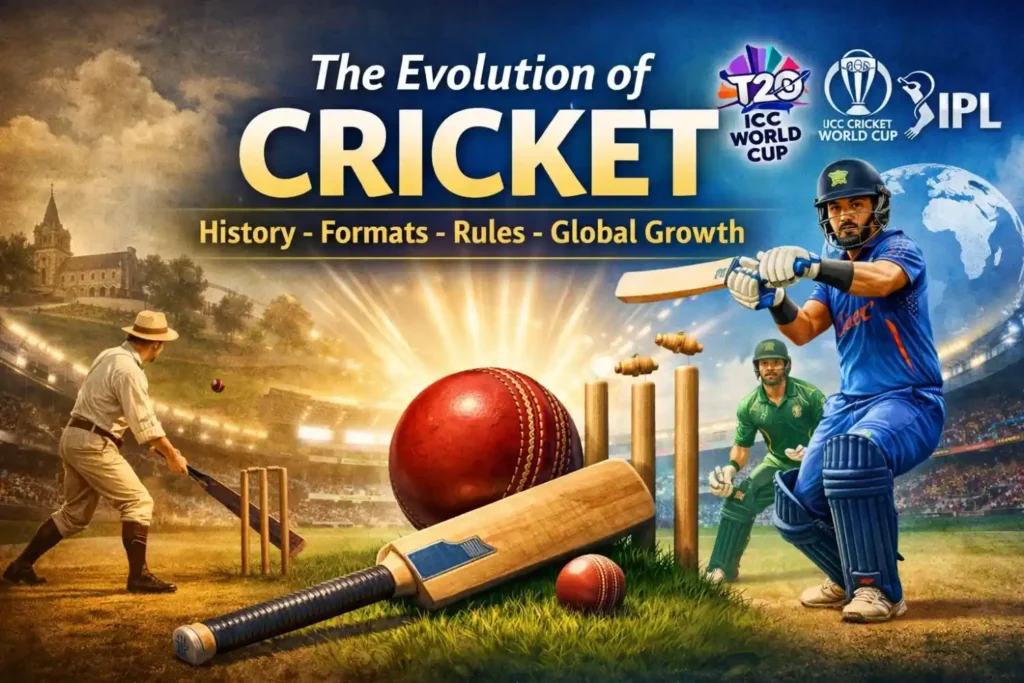
Cricket is more than just a sport — it is a tradition, a profession, and a passion shared by millions across the world. From historic Test matches to fast-paced T20 leagues, cricket has evolved significantly over the centuries. In this detailed guide, we explore the origins of cricket, its formats, basic rules, global tournaments, and how the game continues to grow worldwide.
This type of well-researched, factual content helps improve website authority, topical depth, and Google trust signals.
Table of Contents
Toggle1. History of Cricket
Cricket originated in England during the 16th century. It gradually became popular across the British Empire and is now played professionally in more than 100 countries.
The sport is governed globally by the International Cricket Council (ICC), which organizes major tournaments and regulates international rules.
Over time, cricket expanded into Asia, Australia, Africa, and the Caribbean, becoming especially popular in countries like India, Australia, England, Pakistan, and South Africa.
2. Formats of Cricket
Cricket is played in three main international formats:
(A) Test Cricket
- Oldest format (played up to 5 days)
- Each team bats twice
- Focus on endurance, patience, and technique
The ICC World Test Championship determines the top Test nation in a cycle format.
(B) One Day Internationals (ODIs)
- 50 overs per side
- Introduced to create a result within one day
- Balanced mix of patience and aggression
The biggest ODI tournament is the ICC Cricket World Cup.
(C) T20 Internationals
- 20 overs per side
- Fast-paced and entertainment-focused
- Encourages aggressive batting and innovative bowling
The ICC Men’s T20 World Cup is the premier global T20 competition.
3. Basic Rules of Cricket
For informational clarity, here are core cricket rules:
- Each team has 11 players.
- One team bats while the other bowls and fields.
- The batting team aims to score runs.
- The bowling team aims to dismiss batters.
- An over consists of 6 legal deliveries.
- A match ends after fixed overs (ODI/T20) or time limit (Test).
Ways a batter can get out:
- Bowled
- Caught
- LBW (Leg Before Wicket)
- Run Out
- Stumped
4. Key Skills in Cricket
Batting
Requires:
- Timing
- Shot selection
- Footwork
- Strike rotation
Bowling
Types:
- Fast Bowling
- Swing Bowling
- Spin Bowling (Off-spin & Leg-spin)
Fielding
Modern cricket places heavy emphasis on:
- Direct hits
- Athletic catches
- Ground fielding efficiency
5. Role of Domestic & Franchise Leagues
Domestic leagues have transformed cricket’s financial and global appeal. One of the most influential tournaments is the Indian Premier League (IPL).
Other major leagues include:
- Big Bash League (Australia)
- The Hundred (England)
- Pakistan Super League
- SA20 (South Africa)
These leagues:
- Provide international exposure
- Increase player earnings
- Develop young talent
6. Technology in Modern Cricket
Technology has improved fairness and accuracy:
- DRS (Decision Review System)
- Hawk-Eye ball tracking
- UltraEdge (snickometer)
- LED stumps
These innovations enhance transparency and maintain integrity in the sport.
7. Global Growth of Cricket
Cricket is expanding beyond traditional nations. Countries like USA, UAE, Nepal, and Netherlands are increasingly competitive.
The ICC continues promoting:
- Associate nation development
- Women’s cricket expansion
- Youth tournaments
Women’s cricket has also grown significantly, with increasing audience engagement and global tournaments.
8. Why Cricket Remains Popular
Cricket remains one of the most followed sports because:
- It combines strategy and skill
- It adapts to modern audiences (T20 format)
- It connects generations
- It has strong international rivalries
Major rivalries such as India vs Pakistan or Australia vs England (The Ashes) attract global attention.
Conclusion
Cricket has evolved from a traditional English pastime into a global sporting powerhouse. With structured international governance, multiple formats, advanced technology, and worldwide participation, the game continues to grow.
Frequently Asked Questions (FAQs)
Q1. Where did cricket originate?
Cricket originated in England during the 16th century and gradually spread to other parts of the world through British influence.
Q2. How many formats are there in international cricket?
There are three main formats in international cricket: Test matches, One Day Internationals (ODIs), and Twenty20 Internationals (T20Is).
Q3. What is the role of the ICC in cricket?
The International Cricket Council (ICC) is the global governing body of cricket. It organizes major international tournaments and sets the rules and regulations for the game.
Q4. What is the difference between Test, ODI, and T20 cricket?
Test cricket is played over five days, ODIs are limited to 50 overs per side, and T20 matches are limited to 20 overs per side. Each format requires different strategies and playing styles.
Q5. Why is T20 cricket so popular?
T20 cricket is popular because it is fast-paced, entertaining, and typically completed within three hours, making it more accessible for modern audiences.