
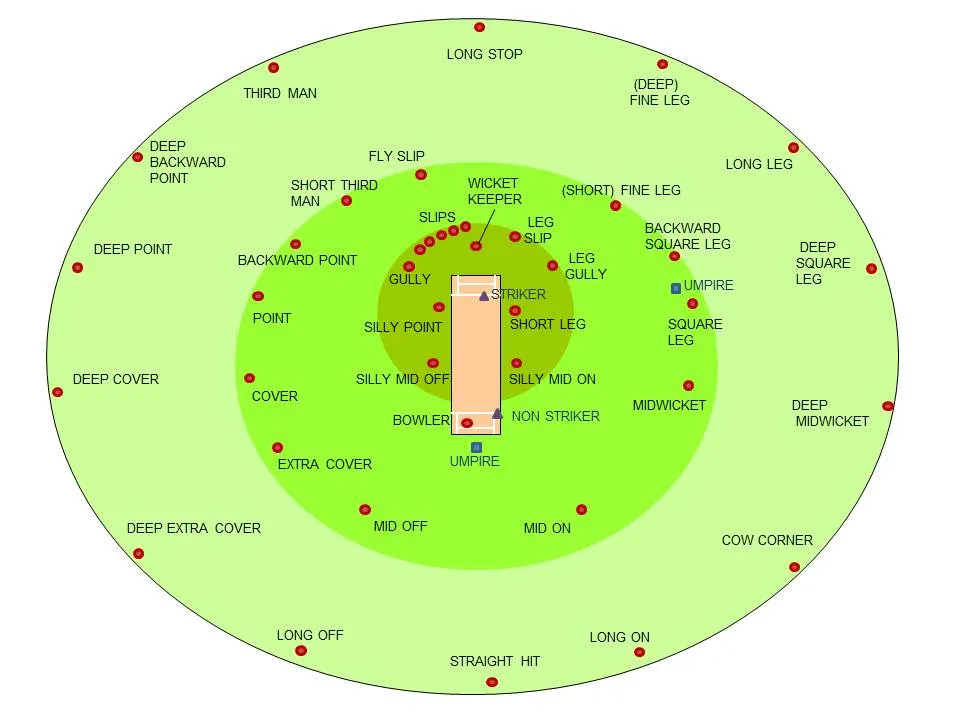
Cricket has a rich history and its own set of complexities, and one thing that has always confused beginners is the sheer variety of fielding positions. Understanding these positions, though, is key to grasping the strategy and tactics involved in the game. This guide breaks down cricket field positions and their roles, making it easier for beginners to understand the field setup and how each player contributes to the team’s success.
Table of Contents
ToggleUnderstanding the Cricket Field
A cricket field is usually circular or oval, with the pitch positioned at the center. The pitch is where the bowler delivers the ball to the batter, and the fielding team places its players around the ground — some close to the pitch (the infield) and others near the boundary (the outfield). The boundary marks the edge of the field, and runs are scored when the ball crosses it.
Fielding positions are broadly classified into infield and outfield roles. Each position serves a specific purpose — stopping runs, creating wicket-taking opportunities, or cutting off boundaries.
Common Infield Positions
- Slip(s): Positioned behind the batter, slips are crucial for catching edges nicked off fast bowlers. They stand in a line starting from first slip, with more slips added depending on the bowling strategy.
- Gully: Positioned at an angle between slip and point, gully catches balls that fly off the bat from aggressive shots — complementing the slips by covering wider edges.
- Point: Stationed square of the wicket on the off side, this position is key for stopping powerful square cuts and drives played in that direction.
- Cover: Positioned slightly ahead of point on the off side, cover stops drives and aggressive shots played in front of the batter.
Common Outfield Positions
- Deep Mid-Wicket: On the leg side near the boundary, this position stops lofted shots from aggressive batters.
- Long-Off & Long-On: In line with the batter, these fielders stop lofted drives from reaching the boundary.
The Wicketkeeper
The wicketkeeper is one of the most important positions on the field, standing directly behind the stumps at the batter’s end. Their role is to catch any deliveries the batter misses, attempt stumpings, and support run-outs. They also help set the field by guiding the captain, thanks to their close-up view of the batter’s stance and shot selection.
How Field Placements Change by Format
In Test cricket, fielding positions are set for patience, with a focus on catching and stopping runs over long spells. Close catching positions like slips, short leg, and gully are common, taking advantage of any errors by the batter.
In ODIs, fielding strategy balances attack and run-saving. Outfielders are used more often to prevent boundaries, while the infield focuses on cutting off singles and forcing dot balls.
Against fast bowlers, fielders are typically placed in positions that maximize catching opportunities — slips, gully, and point are prominent, with outfielders like third man and fine leg set to prevent boundaries.
Against spin bowlers, captains usually set a more attacking field, with close catchers like short leg and slip in position. Outfielders like deep mid-wicket and long-on are placed to prevent big hits against slower deliveries.
Final Thoughts
For beginners, understanding fielding positions can feel overwhelming at first. Visual aids like field diagrams can help you grasp the layout more quickly — and the more cricket you watch with this knowledge in mind, the more naturally it will click.