
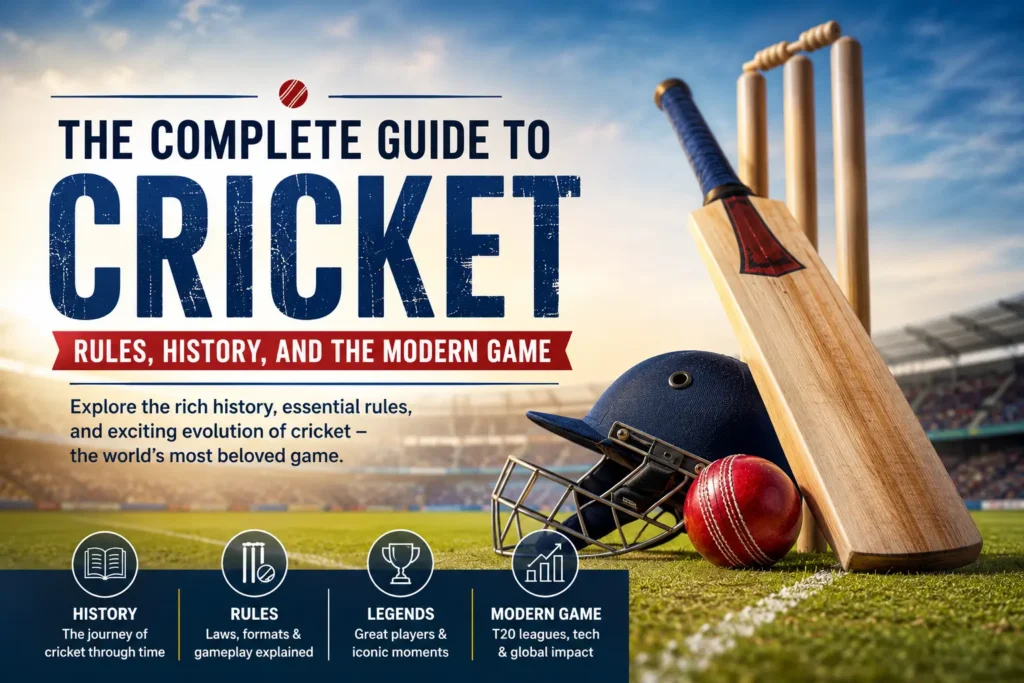
Cricket is one of the most followed sports in the world, with a passionate fan base spread across India, England, Australia, Pakistan, South Africa, the West Indies, and many other nations. For newcomers, the game can seem complex with its unique terminology and formats. This guide breaks down everything you need to know — from the basic rules to the history of the sport and the tournaments that define it today.
Table of Contents
ToggleA Brief History of Cricket
Cricket’s origins trace back to 16th-century England, where it began as a rural pastime played by children in the countryside. By the 18th century, it had developed into a structured sport with formal rules, and the Marylebone Cricket Club (MCC), founded in 1787, became the guardian of the Laws of Cricket — a role it still holds today.
The sport spread across the British Empire, taking root in India, Australia, South Africa, and the Caribbean. The first official Test match was played between Australia and England in 1877, marking the beginning of international cricket as we know it. Over the next century, cricket evolved from a game played over several days into shorter, more dynamic formats designed to attract wider audiences.
Understanding the Basic Rules
At its core, cricket is played between two teams of eleven players each. One team bats while the other bowls and fields. The batting team tries to score runs, while the bowling team tries to dismiss batsmen and restrict scoring.
Key elements of the game:
- The Pitch: A 22-yard strip in the center of the field where most of the action takes place, with a wicket (three stumps and two bails) at each end.
- Runs: Scored by batsmen running between the wickets, or by hitting the ball to the boundary — four runs for a shot that reaches the boundary along the ground, and six runs if it clears the boundary without bouncing.
- Overs: A set of six balls bowled by one bowler, after which a different bowler takes over from the opposite end.
- Dismissals: A batsman can be out in several ways, including being bowled, caught, run out, stumped, or leg before wicket (LBW).
- Innings: A team’s turn to bat. The number of innings and overs depends on the format being played.
The Three Main Formats of Cricket
Test Cricket
The oldest and longest format, played over five days with unlimited overs per innings. Test cricket is often considered the purest test of skill, patience, and endurance, rewarding technique and mental resilience over flashy stroke play.
One Day Internationals (ODIs)
Introduced in the 1970s, ODIs limit each team to 50 overs per innings, with the match typically completed in a single day. The Cricket World Cup, held every four years, is played in this format and remains one of the most prestigious tournaments in the sport.
Twenty20 (T20)
The newest and fastest format, limited to 20 overs per side and usually completed in about three hours. T20 cricket has transformed the sport’s popularity, bringing in new fans with its high-scoring, fast-paced style. The T20 World Cup and domestic leagues around the world have made this format a global phenomenon.
Major Cricket Tournaments Around the World
- ICC Cricket World Cup (ODI format): The pinnacle event in one-day cricket, contested by the top cricketing nations.
- ICC T20 World Cup: The premier global tournament for the T20 format.
- ICC World Test Championship: A league system determining the best Test team over a two-year cycle.
- Indian Premier League (IPL): One of the most-watched domestic T20 leagues globally, featuring franchise teams and top international players.
- Big Bash League (BBL): Australia’s major domestic T20 competition.
- The Ashes: The historic Test series between England and Australia, dating back to 1882.
- Asia Cup: A tournament contested among cricketing nations from the Asian continent.
Legendary Players Who Shaped the Game
Cricket has produced many icons whose records and playing styles continue to influence the sport:
- Sir Donald Bradman (Australia): Widely regarded as the greatest batsman in history, with a Test batting average of 99.94.
- Sachin Tendulkar (India): Holder of numerous batting records, including the most international centuries.
- Sir Vivian Richards (West Indies): Known for his dominant and fearless batting style during the 1970s and 80s.
- Shane Warne (Australia): One of the greatest spin bowlers, credited with reviving interest in leg-spin bowling.
- Virat Kohli (India): A modern-day batting great known for his consistency across all formats.
Why Cricket Continues to Grow in Popularity
Cricket’s appeal lies in its blend of strategy, skill, and unpredictability. Each format offers something different — Test cricket rewards patience and technique, ODIs balance strategy with pace, and T20 cricket delivers non-stop entertainment. The rise of domestic leagues has also given fans the chance to watch top international talent playing alongside emerging local players, further boosting the sport’s global reach.
With technology like the Decision Review System (DRS), ball-tracking, and advanced analytics now part of the modern game, cricket continues to evolve while staying true to its century-old traditions.
Conclusion
Whether you’re new to the sport or a longtime follower, understanding cricket’s rules, history, and formats helps you appreciate the game on a deeper level. From village greens in 16th-century England to packed stadiums hosting the IPL and World Cup finals, cricket has grown into a truly global sport — one that continues to capture the hearts of millions of fans.
Also Read: The Economics of Cricket: A Deep Dive